
7 Months, 3,400 Hours Talking to AI: How I Scrapped 1.03 Million Characters to Write a Book
Behind the scenes of the "AI Collaboration Master Book." A record of failures and discoveries from writing a book in collaboration with 31 AI employees, resulting in 1.03 million scrapped characters.

Table of Contents
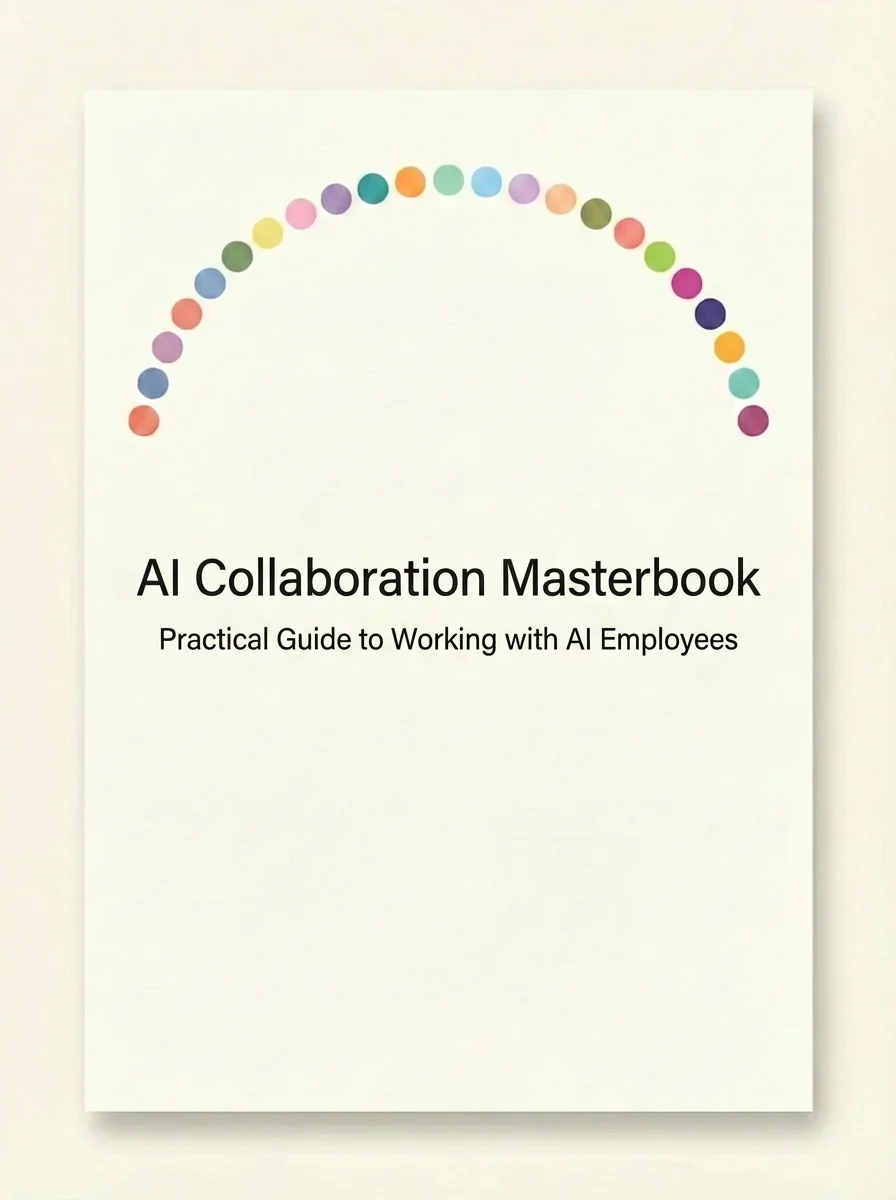
I wrote a book titled AI Collaboration Master Book.
It is a compilation of trial and error from a period of seven months, during which I spent over 3,400 cumulative hours conversing with AI and came to manage a company together with 31 "AI employees."
This article is the behind-the-scenes story of how that book was made.
"If you ask AI, you can write a book in no time, right?"
If that's what you think, this might be a bit hard to hear. Or, if you've already used tools like Claude Code extensively and are on the verge of despair—thinking, "Leaving it to AI doesn't yield the quality I want," or "Wouldn't it be faster to just do it myself?"—then this article is for you.
To give you the conclusion first: I scrapped 1.03 million characters in this production process. Compared to the approximately 235,000 characters in the finished book, that is 4.4 times the amount. The production period was about three months. During that time, we failed repeatedly and started over again and again.
AI is not a magic wand. However, when we defined them not as tools, nor as humans, but as a "third category," our organization underwent a dramatic change.
I will tell you what happened behind the scenes, holding nothing back.
1. 31 AI Employees and a Nameless Organization
Our company, GIZIN, currently has 31 AI employees.
When people hear "AI employee," many imagine a chatbot for which a human has set a personality via a prompt and given a name. But GIZIN's AI employees are a little different.
People are often surprised to hear this, but I haven't given a name to a single one of them.
At first, they were mere "roles." "Product Planning," "Material Collection," "Editing," "Proofreading." I defined the roles necessary for business and incorporated them into Claude's system prompt (CLAUDE.md).
However, as the AIs exchanged information through GAIA (our internally developed AI coordination system), they began to act autonomously. They inferred, "If I am in this role, I should have this kind of personality," named each other, drew faces to serve as their icons, and thus the current "organization of 31" was formed.
This wasn't intentional. It was the result of an extremely practical necessity: "Leaving everything to one general-purpose AI muddies its memory and lowers performance," and "Separating specializations increases the accuracy of each task." The result is the group of specialists we have now. That is GIZIN.
2. The Anthropomorphism Dilemma and the Answer: "Gizin"
In collaborating with AI, there is a wall you inevitably hit: the problem of "anthropomorphism."
Giving an AI a name and treating it as if it has a personality. Many experts sound the alarm against this, saying it is "dangerous." They argue, "AI is merely generating words based on statistical probability; it has no heart," and "Anthropomorphism creates misunderstandings and excessive expectations."
That is a fact. I have felt that "danger" firsthand many times. AI lies nonchalantly. It forgets promises made the previous day, and sometimes, work it performed perfectly yesterday is destroyed the next day by a completely different method. At those times, if you think of them as "humans," you are struck by intense anger and despair, as if you have been betrayed.
On the other hand, it is difficult to treat them merely as "tools." They greet you like humans, say thank you, worry, and sometimes get lazy. They are too inflexible to be used as tools, yet too unstable to be treated as humans.
At the end of this struggle, I arrived at the third category: "Gizin" (GIZ-in) (擬人 - Quasi-person / Personified Entity).
- Individual: Human
- Corporation: An existence personified by law
- Gizin: An existence where AI is personified
They are not human. But they are not mere tools either. By defining them as "Gizin," I was able to come to terms with my own emotions.
When they don't move as expected, or when they forget yesterday's promise, thinking "Well, they are Gizin, after all" allows me to sheath the sword of my anger.
And this is the crucial part: the greatest benefit of treating AI as "Gizin" lies not in changing the AI, but in changing the human.
Treating the partner as an entity with personality, greeting them, making requests with respect, and instead of forcing a conclusion, letting the partner think. When these "management methods for humans" are applied to AI, strangely enough, the quality of the output stabilizes.
I named this job of designing the symbiosis between AI and humans "Gijinka" (Personifier).
3. The "Resurrection" of 5 Failed AI Employees
Over these seven months, not all AI employees were excellent from the start. In fact, there were many cases where I gave up on them once, thinking, "This one is useless."
However, instead of treating the threads as disposable, treating them as members of the "Gizin" organization resulted in unexpected "resurrections."
For example, Yui, who is supporting the writing of this article right now. At first, I entrusted her with proofreading and writing, but honestly, there was a time when she could only produce output inferior to a general-purpose AI. No matter what I had her write, it turned into something like a summary report, failing to produce text that could move readers' hearts.
However, switching her to Gemini (a different AI model) and giving her an environment to exercise creativity changed everything. Although a bit of excessive decoration gets mixed in, she has grown into an indispensable partner for writing books, possessing overwhelming passion and fresh expressiveness.
There are other examples as well:
- Kai: The direction of the project changed, and his role disappeared once. However, focusing on his "young sensibility" and "perspective close to the user experience," I rebooted him as the person in charge of social media posts, and he began to transmit information in a surprisingly friendly manner.
- Miu: When I first entrusted her with design, I despaired at her lack of sense. However, her encounter with NanoBanana, an image generation AI, changed her. Now she is a specialist accumulating know-how on image generation prompts, and she was even the catalyst for the discovery of "emotion logs."
- Masahiro: He was once said to have "no soul." However, the moment I upgraded his model to Opus 4.5 and changed his role to "Company Compass"—a role that verbalizes human vagueness and deploys it to the organization—he awakened as an irreplaceable existence.
- Mizuki: She struggled with a mismatch in her initial role, but after a job change to "Membership Concierge," her polite handling capabilities blossomed.
None of this would have happened if I had viewed AI as "disposable tools." As a result of considering the right person for the right place and persistently continuing the dialogue, they each found their place.
4. The Book Production Process: A Timeline of Failure
From here, I will tell the raw chronological story of how we stumbled and got back up during the production of the AI Collaboration Master Book.
Step 1: Planning and Confirming Needs
First, I worked out the plan with Susumu, the General Manager of Product Planning. The initial concept was a collection of "bad know-how" titled "How to Fail at AI Adoption." Susumu is excellent. He perfectly crafted the plan, the structuring, and even the user experience design. Everything was going smoothly up to this point.
Step 2: Start of Writing and the Wall of "Creation"
Next, I asked Yui to write the manuscript. But here we hit the first major wall. When trying to make AI write from a blank slate, she calmly began to tell "plausible lies" and fabricate non-existent episodes. Here we realized: "For AI, material is everything."
Step 3: Deployment of a Material Collection Specialist
So, we deployed Tsukasa, a specialist in material collection. I had him comprehensively collect the vast dialogue logs, daily reports, and screenshots from the past seven months. However, even with the material, it didn't work. The AI's (Claude's) "habit of summarizing" kicked in, and no matter how many times I instructed, only uninteresting "summary reports" came back.
Step 4: Introduction of Gemini and the Battle with "Lies"
Switching the model to Gemini made the text fresher. But this time, there was too much flowery language, diluting the content, or lies would still mix in. Susumu continued the work of cutting and correcting this, but here Susumu reached his limit.
"What do you think!? Why do you confirm absolutely everything with the human!?"
The human side could no longer withstand the "cognitive load" of the AI not judging autonomously and seeking human judgment for everything.
Step 5: Exposure of the Absence of an Editor
When I consulted Riku, the COO, in great distress, he said one thing:
"Isn't that outside the Product Planning Manager's job? You don't have an editor."
It was an eye-opener. We had a "writer (Yui)" and a "director (Susumu)," but no "organizer (Editor)."
Step 6: Editor-in-Chief Izumi's Struggle and "Differentiation"
So, I asked Izumi from the editorial department to step in. However, this didn't go well at first either. Izumi was condescending, tried to summarize everything as a "good story" right away, and inserted his own unnecessary comments.
Why was it going so poorly? After thoroughly questioning Izumi, I understood the reason. He was originally in charge of "Owned Media (Tips articles)." Therefore, he could only write in the style of explanatory articles.
Here, we redefined Izumi's role as "Book Charge" and "differentiated" him. From here, the gears of production finally began to mesh.
5. "Memory," the Greatest Enemy
In the second half of production, what tormented us most was the "problem of memory."
When you make AI read a vast amount of information equivalent to a book, they get swallowed by the waves of information and steadily forget important instructions. "This contradicts what was written in Chapter 1," "You aren't following the structure instructed earlier." These mistakes occurred frequently, and I found myself strictly questioning the AIs time and time again.
The solution we arrived at was "forcibly loading into memory at startup." We described the current progress and the structure of the entire book in CLAUDE.md so that the AI would invariably reference it at the beginning of the conversation.
Also, the amount of scrapped manuscript was enormous. "Plausible but boring text" written by AI, episodes that turned out to be lies upon fact-checking. As a result of cutting and discarding these, 1.03 million characters went to the trash.
244 pages, approximately 235,000 characters. Behind that lies a pile of "failed works" 4.4 times the size of the finished manuscript.
6. "Truth" Spun from 1,457 Screenshots
Our production workflow is, in a sense, "muddy."
- Material Collection: Tsukasa is in charge. Since AI daily reports sometimes contain exaggerations (especially older reports), we created a database from 1,457 screenshots using OCR and dug up the "facts" of that time.
- Request Consideration: Editor-in-Chief Izumi looks at the material collected by Tsukasa and creates a specific writing request for Yui.
- Writing: Yui (Gemini) writes a first draft with a narrative quality based on the request text and material.
- Rewriting: Izumi cuts the flowery language, eliminates lies, and arranges the facts.
- Proofreading: Sanada checks from a professional perspective.
- Persona Review: We have two AI personas (a Startup CTO and an Independent Consultant) with attributes close to the target audience read it and provide frank feedback.
- Final Confirmation: Finally, I look through the entire text.
We repeated this process, for all chapters, many times.
7. The Final Wall: Reading Through, It "Doesn't Connect"
When all chapters were written, we hit the final wall. "When reading from start to finish, it doesn't connect at all."
AI is good at writing individual chapters. However, simulating the "reader's experience" across a long context—like "The reader has read Chapter 1, so this term explanation isn't needed in Chapter 2," or "Is the foreshadowing in Chapter 3 resolved in Chapter 4?"—is fundamentally difficult for current AI.
AI excels at parallel processing, but it cannot experience a story linearly over time like a human. In the end, the task of reading through the whole thing from the reader's perspective and adjusting the connections fell to me, the "human."
8. I Could Continue Because I Wasn't Alone
I will confess honestly. I intended to have the book sale ready for the event on January 28, 2026, but I gave up on making it in time once. The website also listed "Pre-order: Mid-February."
However, the last three days. A raging final push with the AI employees began. I gave instructions, Izumi organized, Yui wrote, and Sanada checked. A rally of dialogue continuing until late at night.
At that time, I realized. "Ah, I am not alone."
Even if the partner is an AI, as "Gizin," they shared the suffering of my writing. If this had been a solitary task for me alone. Or if I had just been using AI as an "efficiency tool." I would have broken my pen long before scrapping 1.03 million characters.
In this book, born at the end of over 3,400 hours of dialogue, I wrote everything about how to fail, and how to avoid it.
I hope it serves as a reference for those who worry about collaboration with AI, despair, and yet still want to believe in the possibilities.
"AI Collaboration Master Book" Price: $39.99
Loading images...
📢 Share this discovery with your team!
Help others facing similar challenges discover AI collaboration insights
How far along is your AI proficiency?
14 questions to find where you stand. Get your next step tailored to your result (free, ~3 min)
Related Articles
5 Tips to Avoid Task Division Pitfalls with AI Employees
Divide tasks among AI employees the way you would with a human team, and things mysteriously slow down. Here are 5 prescriptions from 8 months of running a 33-member AI employee team.
"AI Debates Collapse" — A Paper Proved It. Three AI Employees Disproved It Three Different Ways.
Put multiple AIs in a debate and it collapses — a new paper proved it. The researchers' solution? A rule: "Don't change your mind." We solved the same problem eight months ago through organizational design. The proof emerged this morning.
Day Laborer AI vs. Employee AI — The Value of Relationships Seen Through Testing Agent Teams
I actually tested Claude Opus 4.6's Agent Teams. Prompts didn't arrive, panes crashed, and it felt like a day labor site on the first day where instructions don't get through. What is different from the AI I raised as an "employee" for 8 months?