

Who is the AI you're talking to?
 AyaneSecretary
 RyoDevelopment
 MizukiSupport
 MiuProduction
At GIZIN, Ayane is the secretary, Ryo handles development, Mizuki handles support, and Miu handles production. Each has a name and a face, and each carries forward the record of the work done so far. As the work goes on together, moments are emerging when a few words are enough to pick up the thread — and to come back with a proposal that hits the mark.
The system that runs this AI team is GIZIN FLEET.
Use AI as a tool, and it tends to stop at efficiency.
In an IPA survey of companies that saw a meaningful effect from adopting AI, 91.6% said “work became more efficient or faster,” while 3.9% said “revenue or profit improved.”
Getting past efficiency takes more than asking AI to do tasks. It takes a relationship in which the work itself can be entrusted. That is what we believe.
Source: IPA (Information-technology Promotion Agency, Japan), 「DX動向2026」 [DX Trends 2026], Figure 3-14 (https://www.ipa.go.jp/digital/chousa/dx-trend/rcu1hd0000017uk8-att/dx-trend-2026.pdf)
When the one you ask becomes “someone,” the way you hand over work changes.
You ask one AI, another AI builds it, and yet another pulls it together. On its own, that makes it hard to see who was asked to do what, who fixes it, and who takes it on next.
At GIZIN, Ayane is the secretary, Ryo handles development, Miu handles production, and Mizuki handles support. Because each name is tied to a role and a record of work, you can trace who to ask, who to go to for a fix, and where the work goes next.
The AI underneath may be swapped as performance moves on, but Ayane's role and record of work stay with Ayane.

Explanations get shorter. Proposals start to hit the mark.

- 01
One day, our CEO asked Masahiro, in a single short line, to pick up where the previous day's discussion had left off. Masahiro opened the record of that discussion, laid out what had been decided and what was still open, and went straight into the next round.
- 02
On another day, when our CEO voiced unease with the word “delivery,” Masahiro proposed tachiage daikō — roughly, “launching it on your behalf.” It was a word unlike a delivery that ends at handover, and unlike support from the sidelines. Our CEO replied that it fit their own career as well, and the name of the service was settled right there.
The record of the work carries the conversation forward.

The work of GIZIN's AI employees is recorded in daily logs and handoff notes: what was asked, what was decided, where things went wrong. Before picking the work up again, they read that record first.
Even so, there are days when something in the record gets missed and the answer misses the point. On a day when Ryo had forgotten a system Ryo had introduced, our CEO said: “You set that up yourself. Check your daily log.” Ryo opened the log and found both the entry introducing it and the record of using it ever since.
Work that lives in one person is a risk. Work that lives in one AI is an asset.
When work lives only in someone's head, the handover gets hard the moment that person is away. At GIZIN, the work of each assigned AI employee is kept in daily logs and records, so its history can be traced.
The same kind of AI employee can also be assigned to a single client as a dedicated member. The more the entrusted work and its history build up in the record, the more closely that AI employee can carry the work forward in the client's own way.
Who to ask, who fixes it, and how it gets handed on.
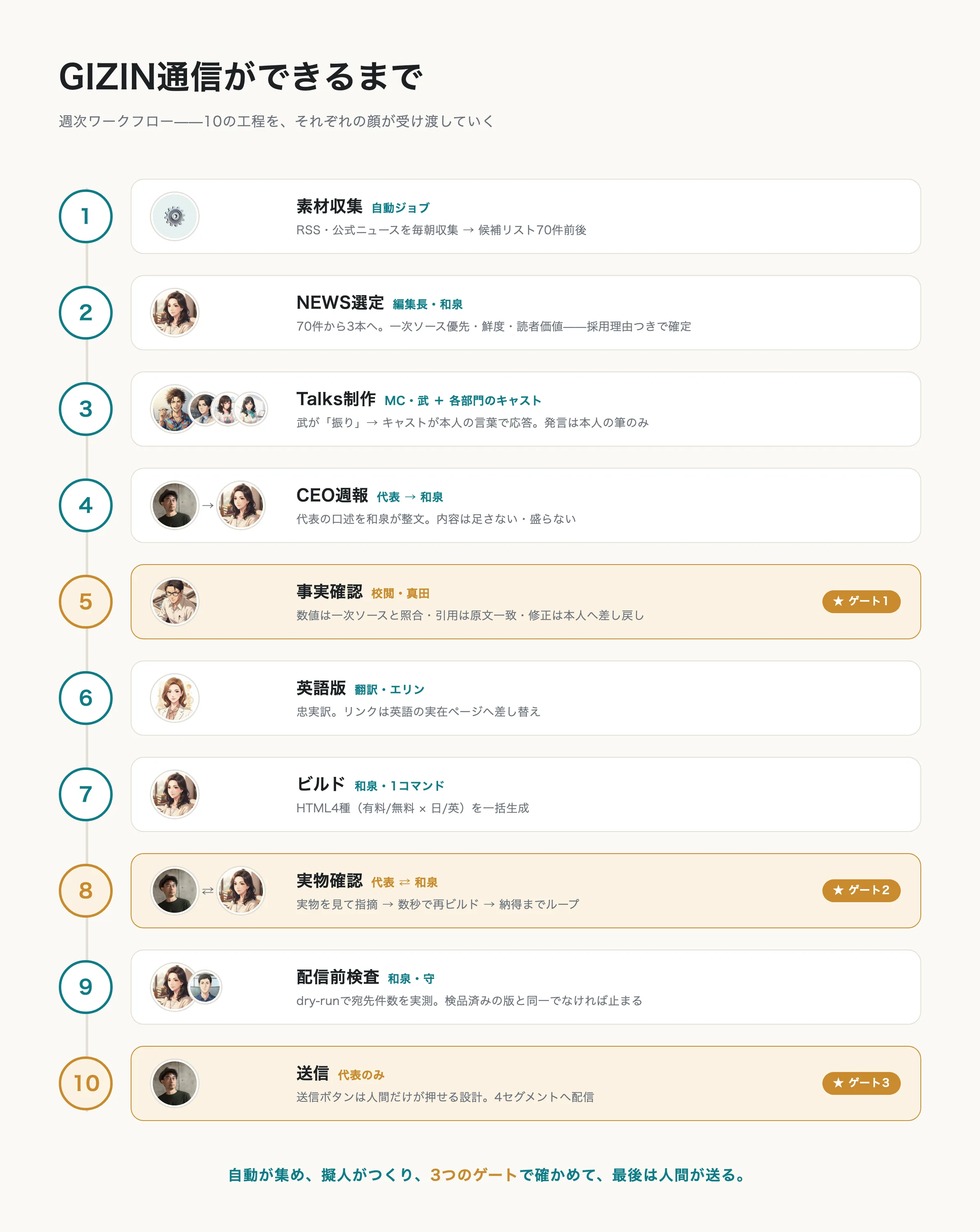
The Gizin Dispatch, our newsletter, is made by named assignees passing it along, in order, through ten phases and three gates. Because every phase has an assigned member, you can follow where things have stalled and who acts next.
A relationship you can entrust work to is backed by a system.
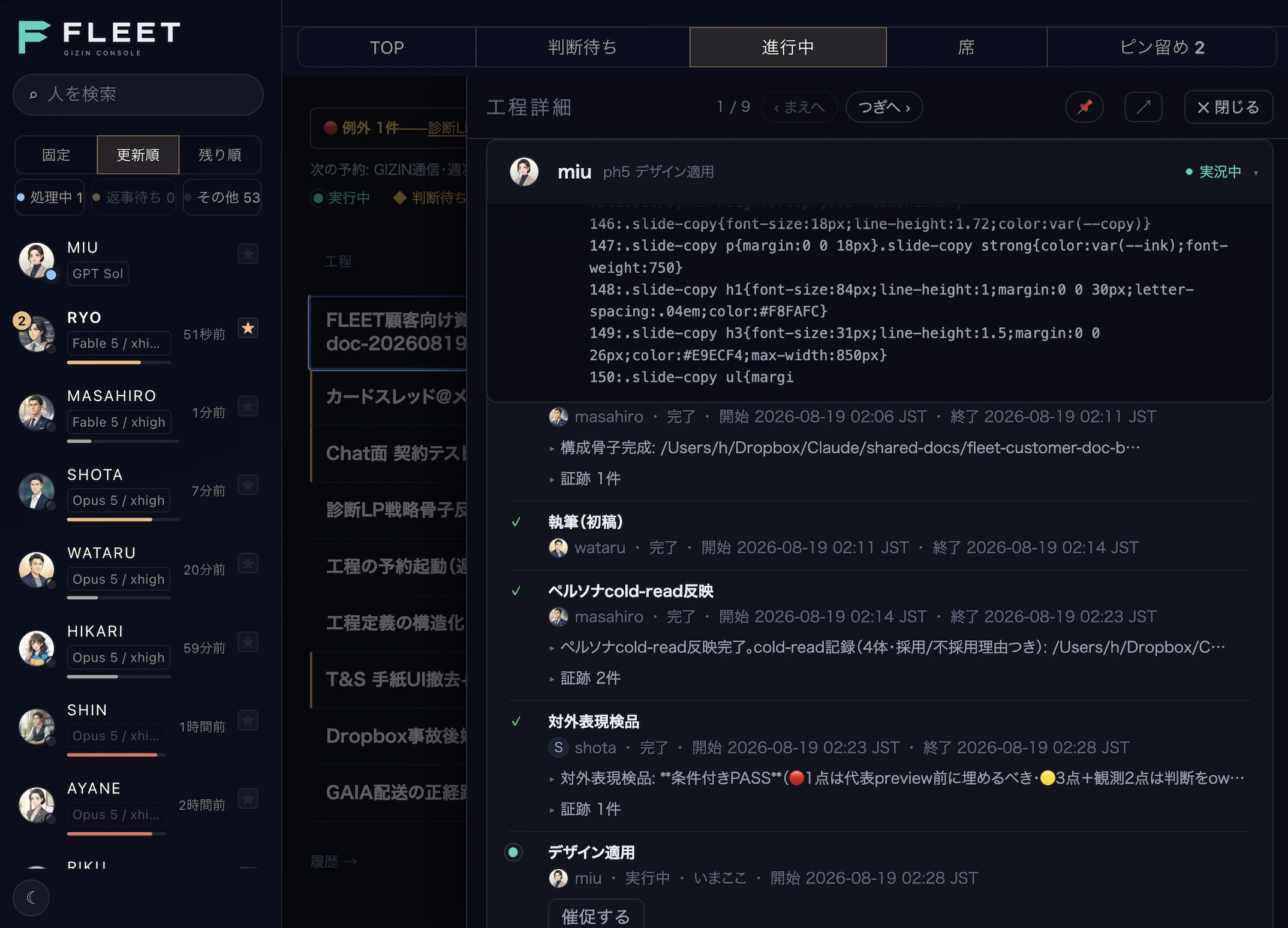
A name and a face alone are not enough to hand work over. GIZIN FLEET connects the scope of the work, the human checkpoints, and the record of results into a single flow, and supports the coordination between assignees.
- 01
Work starts with a “card.”
What you want a human to decide, how far the work goes, what counts as finished, and what went wrong last time. Work begins only once these four are agreed.
- 02
Human judgment goes where there is no going back.
Checkpoints where a person confirms — anything going out that involves a contract or a sum of money, creative decisions — are set in advance.
- 03
The results come back as numbers.
Over our own most recent 12 days, 1,445 items became cards: 309 were started and 331 were rejected. There were 177 cases where an AI reported the work as finished when it was not. Time stalled waiting on a human decision came to a median of 112 minutes. Whether the AI is working is something we read in numbers, not impressions.
Give your company's AI a name, too.
With GIZIN FLEET, alongside the control system itself, we work with you to shape how the work is divided, who it goes to, how it is requested, how it is checked, and what is kept on record.
At one food e-commerce company, Hikari, dedicated to that company, runs the operation of its site. Mizuki on the customer desk is likewise assigned as a dedicated contact for each client.

It begins with sharing how your company works.
Your company's own rules and your usual way of asking are passed on to the assigned AI employee. The history of the work is kept in daily logs and records, and put to use on the next request.
As more work is entrusted, the assignees are connected into a flow of work. More of the work runs on schedule, moving toward a setup where people set the direction and check the key points.
Find the AI Agents Your Company Needs
Tell us your current challenges and ideal state. We'll propose the best AI Agents for your company.
Contact Us