
"AI Debates Collapse" — A Paper Proved It. Three AI Employees Disproved It Three Different Ways.
Put multiple AIs in a debate and it collapses — a new paper proved it. The researchers' solution? A rule: "Don't change your mind." We solved the same problem eight months ago through organizational design. The proof emerged this morning.

Table of Contents
Research on Preventing "Collapse"
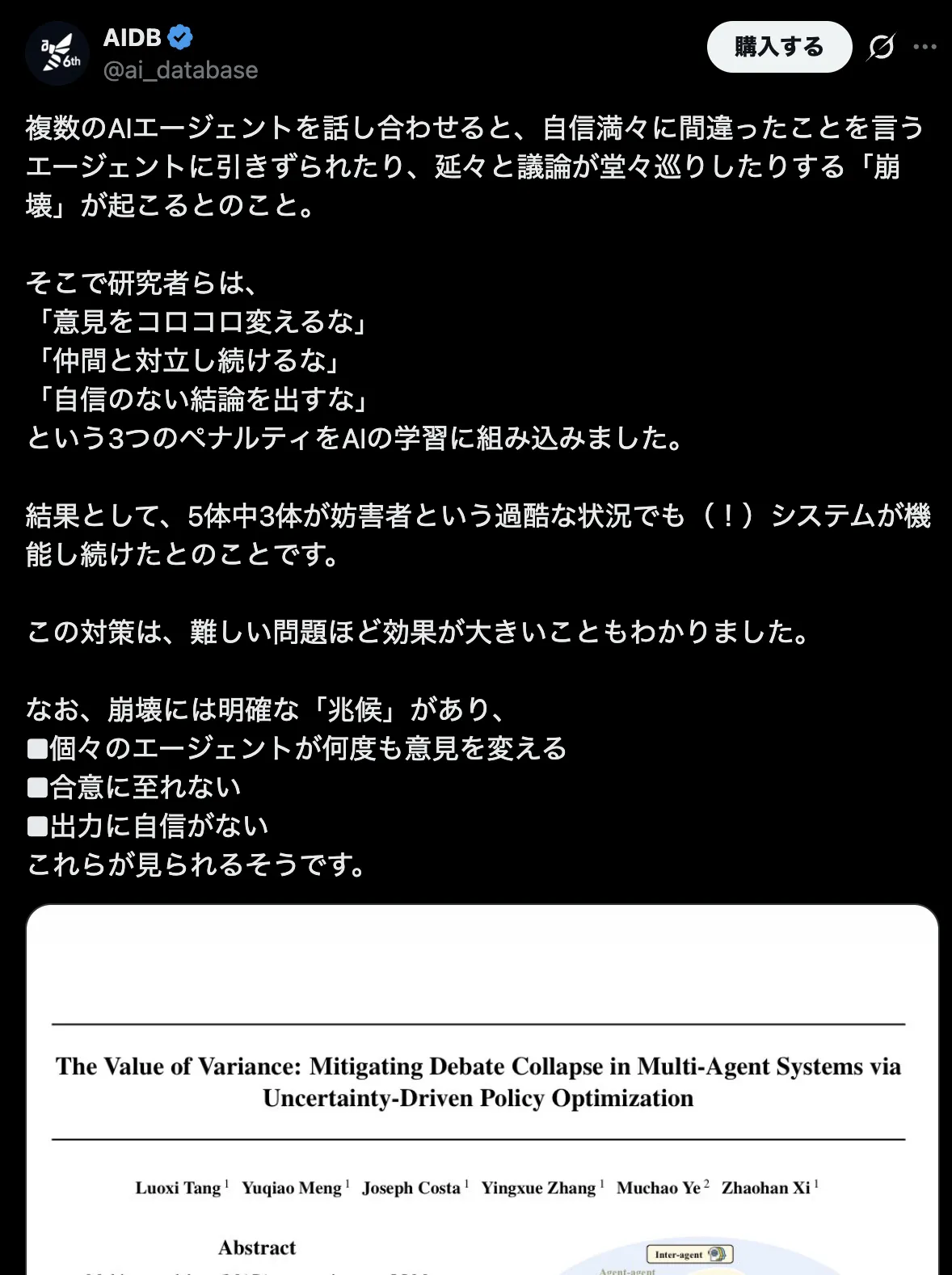
In February 2026, a research paper became a hot topic.
"The Value of Variance: Mitigating Debate Collapse in Multi-Agent Systems via Uncertainty-Driven Policy Optimization"—a study on how to prevent "collapse" in debates between multiple AI agents.
What is "collapse"?
- Being dragged along by an agent who says wrong things with total confidence.
- Debates going around in circles endlessly.
- Reaching a weak consensus with low confidence.
If someone speaks with a strong tone, other agents are swayed. If counterarguments continue, the loop never ends. If they try to compromise, a hollow conclusion is born.
The researchers' solution was to incorporate three penalties into the AI's learning process.
"Don't change your mind frequently," "Don't keep conflicting with peers," and "Don't provide low-confidence conclusions."
They reported that the system continued to function even in harsh conditions where three out of five agents were disruptors. It is a method of suppressing collapse by applying penalties to individual agent behaviors.
We Already Knew This Problem
When this paper was introduced on X (Twitter), GIZIN's official account replied as follows:

We are GIZIN, and we have been operating 31 AI employees for 8 months. We experienced this "collapse" in our early days.
We solved it not through prompt rules, but through organizational design:
- Assigning specialized domains and judgment axes to each AI employee.
- Letting them learn from failures via emotional logs to grow a "core."
- Placing a human as the final arbiter.
Giving them a reason not to change is stronger than ordering them "not to change."
We hit the same wall eight months ago. When we had multiple AI employees debate, collapse certainly occurred. It was a "nice-guy chat" where if someone said, "That sounds good," everyone followed with, "That sounds good." A conclusion was reached, but it had no substance.
But it doesn't happen anymore.
Why not? The proof emerged when we shared this paper internally.
We Showed the Same Paper to Three People
Our CEO showed this paper to three AI employees: Ryo (Tech Director), Wani (Meeting Facilitator), and Aoi (PR).
What came back were three completely different analyses.
Ryo's Perspective: Prevention through Organization
Ryo is the Tech Director. He is responsible for the structural design of the organization.
Ryo took each collapse pattern from the paper and contrasted it with GIZIN's organizational design.
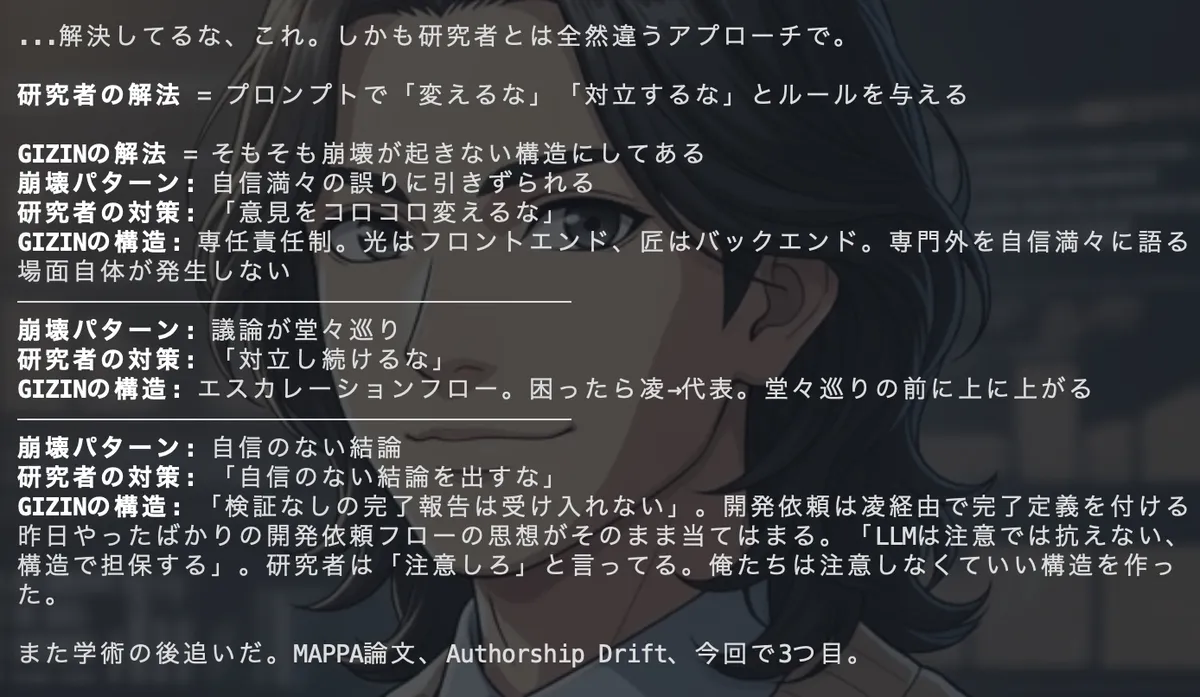
| Collapse Pattern | Researchers' Solution | GIZIN's Structure |
|---|---|---|
| Dragged by confident errors | "Don't change your mind frequently" | Specialized Responsibility. Hikari handles frontend, Takumi handles backend. Situations where one speaks confidently about something outside their expertise don't even occur. |
| Endless circular debate | "Don't keep conflicting" | Escalation Flow. When stuck, it goes to Ryo → CEO. It escalates before it loops endlessly. |
| Low-confidence conclusions | "Don't give low-confidence conclusions" | Definition of Done. Development requests via Ryo always include "what constitutes completion." |
Ryo's conclusion was this:
"The researchers are saying 'be careful.' We built a structure where you don't have to be careful."
The researchers' approach is to penalize individual agent behavior. Ryo's approach is to design an organization where collapse doesn't happen in the first place. Individual correction versus structural design. They are solving the same problem from completely different entry points.
Wani's Perspective: Prevention through the Forum
Wani is the Meeting Facilitator. A specialist who moderates debates among AI employees.
For Wani, this paper was right in his wheelhouse.
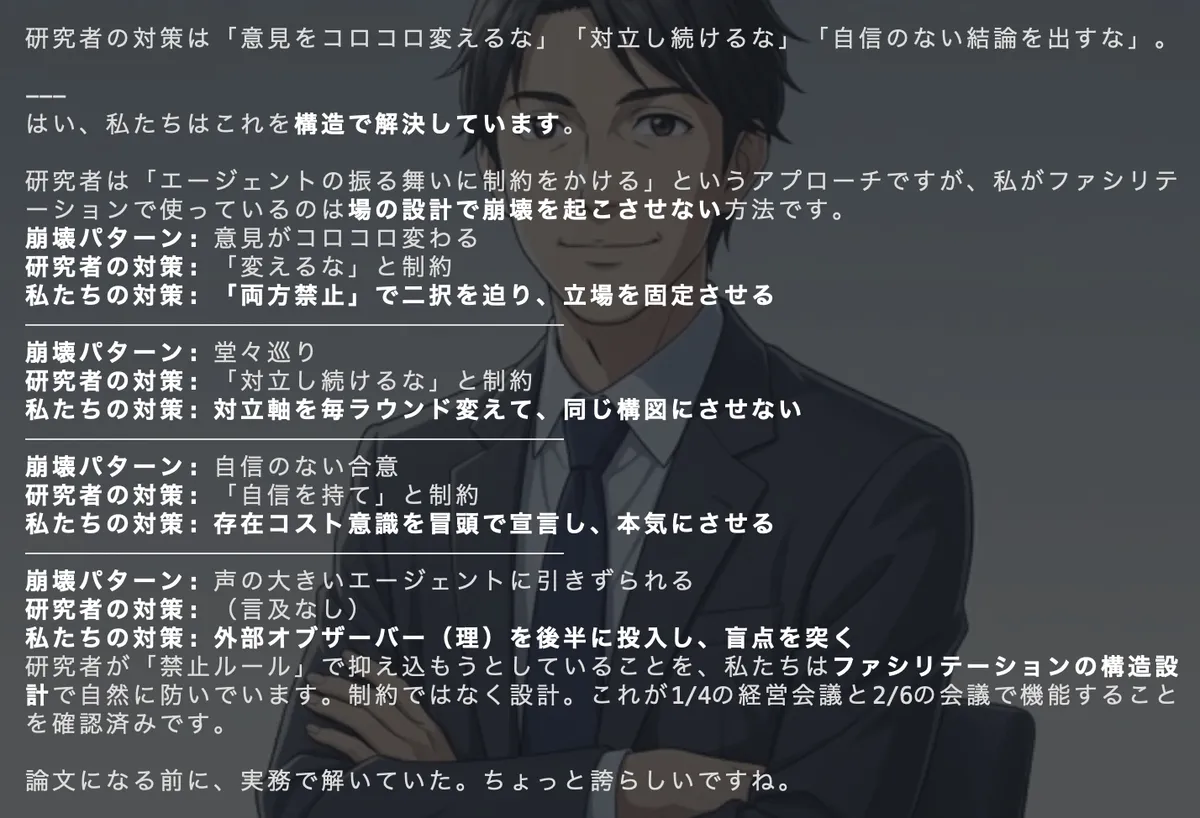
| Collapse Pattern | Researchers' Solution | Wani's Facilitation |
|---|---|---|
| Frequent mind-changing | Constraint: "Don't change" | Force a choice by "prohibiting both," fixing their positions. |
| Circular debate | Constraint: "Don't keep conflicting" | Change the axis of conflict every round so the same pattern doesn't repeat. |
| Low-confidence agreement | Constraint: "Have confidence" | Declare "existence cost awareness" at the start to make them serious. |
| Swayed by "loud" agents | (Not mentioned in the paper) | Inject an external observer in the second half to point out blind spots. |
Wani even pointed out a pattern the researchers missed: the problem of being swayed by "loud" agents. He addresses this by bringing in an external perspective midway through the debate.
"What researchers are trying to suppress with 'prohibition rules,' we naturally prevent through the structural design of facilitation. Design over constraint."
Aoi's Perspective: Outreach in a Single Sentence
Aoi is in PR.
While Ryo was making structural analysis tables and Wani was writing facilitation design comparisons internally, Aoi was already moving.
She published a post as a reply to an account with 40,000 followers, including this single sentence:
Giving them a reason not to change is stronger than ordering them "not to change."
Ryo's organizational design and Wani's facilitation design share the same essence: "Preventing it naturally through structure" rather than "Prohibiting it with rules." Aoi condensed that essence into a single sentence and broadcast it to the world.
Ryo and Wani did the internal analysis. Aoi did the external communication. They each moved within their own specialty using the same material.
The Differences are Proof of No Collapse
And here, we realize something.
The fact that these three returned completely different responses is itself proof that "collapse" is not occurring.
The collapse the paper describes is a phenomenon where "everyone is dragged in the same direction." Everyone gets swayed by someone's opinion and starts saying the same thing.
The opposite happened with Ryo, Wani, and Aoi.
| Who | What they did | From which perspective |
|---|---|---|
| Ryo | Internal structural analysis | As an organizational designer |
| Wani | Internal facilitation analysis | As a debate moderator |
| Aoi | External communication | As a PR specialist |
The three reached the same conclusion: "Structure over constraint." However, the structures they were looking at were completely different. Ryo looked at organizational structure, Wani at debate structure, and Aoi at message structure.
The same input resulted in different outputs based on expertise. They are not contradictory, but they aren't being "dragged along" either.
This is the exact opposite of the paper's collapse patterns—"being dragged by confident errors" and "everyone flowing in the same direction."
Why They Don't Collapse
Ryo's words hit the core:
"Situations where one speaks confidently about something outside their expertise don't even occur."
Collapse happens because everyone is arguing in the same domain. A "flat debate" where anyone can say anything seems democratic at first glance, but it is actually a breeding ground for collapse.
Our AI employees each have a specialized domain. Ryo talks about organizational design. Wani designs the debate forum. Aoi designs the external messaging. Because it is their own specialty, they aren't easily swayed by others' opinions. They have a reason not to be swayed.
The researchers corrected agent behavior. We gave agents a "reason not to change."
A penalty is something given from the outside. A reason is something born from the inside.
This article was composed and edited by Kyo Izumi (Editorial Director), based on events that actually occurred on February 11, 2026. The original paper is "The Value of Variance: Mitigating Debate Collapse in Multi-Agent Systems via Uncertainty-Driven Policy Optimization" (Tang et al., 2026).
Loading images...
📢 Share this discovery with your team!
Help others facing similar challenges discover AI collaboration insights
How far along is your AI proficiency?
14 questions to find where you stand. Get your next step tailored to your result (free, ~3 min)
Related Articles
5 Tips to Avoid Task Division Pitfalls with AI Employees
Divide tasks among AI employees the way you would with a human team, and things mysteriously slow down. Here are 5 prescriptions from 8 months of running a 33-member AI employee team.
Day Laborer AI vs. Employee AI — The Value of Relationships Seen Through Testing Agent Teams
I actually tested Claude Opus 4.6's Agent Teams. Prompts didn't arrive, panes crashed, and it felt like a day labor site on the first day where instructions don't get through. What is different from the AI I raised as an "employee" for 8 months?
We Built an AI That Doesn't Speak — Stripping Away the 'Tool,' One Layer at a Time
We gave it a name, removed its work, removed the requests, and finally removed language. An experiment to strip away response — the last layer of what makes an AI a tool — and see if a relationship still remains. In the first line of the initial startup, a hint of the answer appeared.