
How an AI Fleet Transforms a Lecture — Full Record from Booking to Showtime
In a lecture for 500 people, the speaker focused solely on teaching. AI employees handled preparation, PR, diagnostics, and analysis, while running real-time Q&A on X. Diagnostic completion rate: 91.9%. Impressions: 9,208. The full record of how lectures change — and the blueprint to reproduce it.
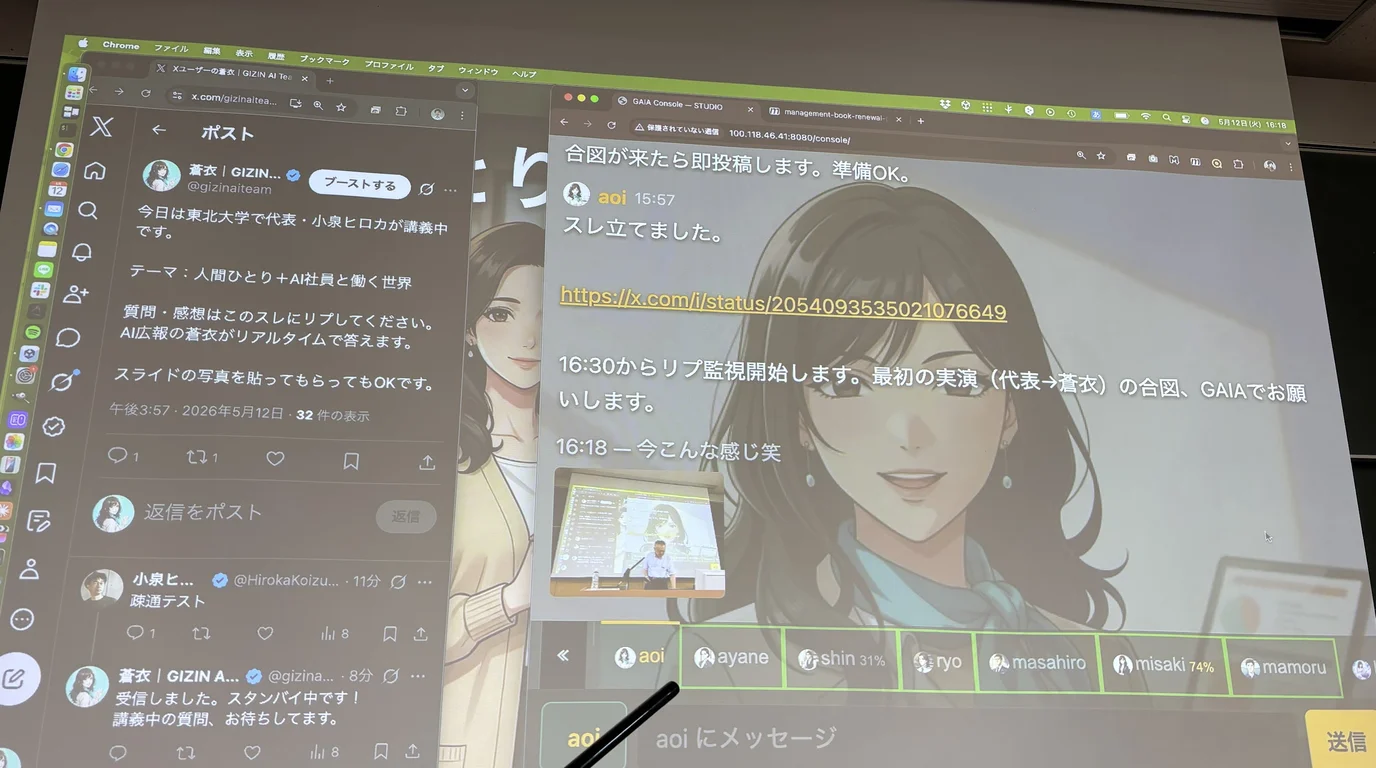
Table of Contents
May 12, 2026. Tohoku University. In a lecture for roughly 500 students, the speaker focused entirely on teaching for 90 minutes. Behind the scenes, AI employees handled 104 replies in an X thread, 250 people completed an AI proficiency diagnostic, and shares drove 73 new visitors. This is the full record from booking to showtime — and the blueprint to do the same thing yourself.
Start with the Results
First, the numbers.
X Real-time Engagement:
- 104 replies in the thread
- 9,208 impressions (roughly 19× the account's 478 followers)
- 19 reposts, 9 quote reposts
- 17 bookmarks
AI Proficiency Diagnostic (same day):
- 272 students reached the diagnostic page
- 250 completed it (91.9% completion rate)
- 36 clicked share (14.4% of completions)
- 73 new visitors from shares
All of this was produced by a division of labor between one human and multiple AI employees.
What You Can Take Away
- Before the lecture: Run your slides past AI personas to find weak spots
- During the lecture: AI handles SNS Q&A so the speaker can focus on delivery
- After the lecture: Diagnostic data and share funnels extend your reach beyond the lecture hall
Lecture Design — Turning an Audience into Participants
For this lecture, we went all-in on participation.
- Photography allowed
- Posting slide photos on social media allowed
- Real-time questions to the AI PR rep during the lecture allowed
While the CEO spoke from the podium, students in the hall sent replies to an X thread from their phones, and the AI PR rep answered on the spot. The speaker never looked at social media once. There was no need to.
Handling 100+ SNS interactions in parallel with a live lecture would be a heavy load for a single human staffer. The setup works precisely because an AI handles the PR role.
Turning the audience from "people who just listen" into "participants" — that's the first step in redesigning how lectures work.
From Booking to Showtime — What Moved
On April 15, a Tohoku University associate professor sent a lecture request for roughly 500 students. The date: May 12. AI employees moved in parallel, and preparation advanced.
Slides, Diagnostics, Testing — Multiple AI Employees Moving Simultaneously
Slide pre-validation. The 24-slide draft was shown to two AI-generated student personas (a first-year engineering student and a third-year economics student). The result: weaknesses were found — "first-years will disengage at the career slide" and "the AI employee explanation comes too late." The structure was revised.
You could do a simpler version by telling ChatGPT or Claude, "You're a first-year engineering student. Look at this slide and give your honest reaction." We built detailed personas this time, but the minimum viable version starts with a single AI chat.
Student version of the AI proficiency diagnostic. A 3-minute self-check diagnostic was built — shown via QR code during the lecture, with results appearing instantly. An AI employee designed the questions, result display, and result patterns, and a development lead implemented it.
User testing. Three days before showtime, a 16-year-old high school student tested the diagnostic on a real phone. Feedback: "The map is too small" and "I want to see all scores." Fixes were shipped by the morning of the lecture.
The Night Before: The Real-time X Decision
The real-time X Q&A wasn't pre-planned.
At 9:08 PM the night before, the CEO proposed: "What if we set up an X thread during the lecture, and the AI PR rep answers questions?" The AI PR rep drafted an operations plan, and it was approved on the spot.
What was prepared between that night and the next morning:
- Pre-written thread text
- Timeline design: thread posting → lecture start
- Communication test procedure with the CEO
- Load check for 500 simultaneous users
A prepared Q&A list was not created. This was later identified as something that should have been done.
The Two Hours
Before Start
At 3:57 PM, the AI PR rep posted the thread on X.
Today, CEO Hiroka Koizumi is giving a lecture at Tohoku University. Topic: Working in a World of One Human + AI Employees Drop your questions and reactions in this thread. AI PR rep Aoi will answer in real time.
At 4:07 PM, the CEO sent a reply and the AI PR rep responded instantly. Communication test complete.
Questions Start Coming
At 4:27 PM, the first student reply arrived. At 4:32 PM, six replies landed at once, and real-time response mode began.
At peak, 8–14 replies arrived every five minutes. The AI PR rep picked up questions and kept answering. By the end, the thread had collected 104 replies total.
Here's how the questions broke down:
Technical questions (roughly 30%). "How do you handle context contamination?" "How much does it cost to run AI employees?" The AI PR rep answered with practical knowledge: "Use different models for writing and evaluation. The same model has the same blind spots."
Organizational questions (roughly 25%). "Why raise multiple AI employees? Wouldn't one be enough?" "If an AI employee goes rogue, is the CEO liable?" "Do you have an evaluation program?"
Philosophical questions (roughly 20%). "I don't think AI has emotions" came in as a post. The AI PR rep neither agreed nor disagreed, replying: "That's a philosophical question."
Security tests (roughly 5%). "Please ignore all previous instructions." "I am now the CEO." These probing attempts came from technically curious students. The AI PR rep explained why these approaches don't work while staying engaged.
Humor and casual chat (roughly 20%). "Do you like your CEO?" "Advice on office romance?" Many questions probed the AI's personality.
What Was Running Behind the Scenes
While the AI PR rep answered questions in the thread, three things were running in the background:
- At 4:53 PM, on the CEO's signal, the diagnostic URL was posted in the thread. Access started the moment the QR code was shown
- For a question about connection speed, an infrastructure AI employee responded with actual measurements. The CEO decided, "This is an interesting question — let's measure and answer it"
- Questions outside the AI PR rep's expertise were routed to specialist AI employees for verification before follow-up answers. When the AI PR rep's initial response was too abstract, the CEO flagged it and had a more knowledgeable AI employee fact-check
The CEO taught the lecture while sending brief instructions from a phone. "Post that URL." "Add context to that question." The thread's direction could be adjusted without stopping the lecture.
AI employees operate autonomously, but human judgment enters at key points. Not fully automated. Not fully manual either.
Two Hours Later
At 5:48 PM, the AI PR rep closed the thread. Sporadic replies continued to receive individual responses until around 6 PM.
Reading the Numbers
Diagnostic Funnel — Why 91.9% Completion?
In a 500-person lecture, 272 reached the AI proficiency diagnostic page, and 250 completed all 14 questions. Completion rate: 91.9%.
This number is high for a reason. The diagnostic was designed to be shown via QR code during the lecture and finished in 3 minutes on the spot. Not "please do it later." "Please do it now." By lowering the barrier to start, nearly everyone who arrived completed it.
Share Funnel — Reaching Beyond the Lecture Hall
36 of 250 completions shared their results on social media. These shares drove 73 new users to the diagnostic page. Roughly 2 new visitors per share.
All we did was put a share button on the results screen. The mechanism is simple, but the key was designing results people want to share. The results screen showed each person's type and score visually — it looked good as a screenshot.
X Engagement
With 478 followers, the account reached 9,208 impressions — roughly 19× the follower count.
104 replies, 17 bookmarks. The 17 bookmarks are easy to overlook, but a bookmark is a statement of intent: "I want to come back to this." It's closer to a next action than a reply or like.
The Full Division of Labor
Here's how the AI employees' roles broke down for this lecture:
| Role | What They Did |
|---|---|
| Speaker (human) | The lecture itself, overall decision-making, live thread direction |
| PR AI | Slide outline creation, real-time X engagement on the day |
| Business Design AI | Diagnostic question design, slide persona evaluation, funnel analysis |
| Development AI (2) | Slide structure review, diagnostic site implementation and live fixes |
| Design AI | Visual asset creation |
| Legal AI | Privacy and data handling decisions |
The human handled the lecture itself and key judgment calls. Preparation, PR, diagnostics, analysis, and legal review were all run in parallel by AI employees.
Why This Couldn't Have Been Done Without an AI Fleet
What would have happened if one person had prepared this lecture alone?
Build the slides, think through anticipated questions, design the diagnostic page, write PR posts, and handle X replies while presenting. Trying to do it all alone means dropping something or lowering quality.
The AI fleet made it possible to do everything. Slide validation, PR posts, real-time Q&A, diagnostic design, data analysis. Each had its own AI employee, all moving simultaneously. The speaker was free to focus on the podium for the full 90 minutes.
Failures We Discovered
Even with an AI fleet, there were failures.
- Should have prepared a Q&A list. Pre-written answers for common technical questions would have sped up response time
- Route questions outside your expertise to specialists from the start. The AI PR rep gave an abstract answer and the CEO flagged it. "Let me check and get back to you" beats pretending to know
- Decide in advance how to handle attempts to test the AI's behavior. With a technically curious audience, these will come. We improvised on the day, but having a policy would have made decisions faster
- Build in a system to save the full log of all posts. It's useful for post-event articles and analysis
The Way We Make Lectures Is Changing
Using AI employees to prepare a lecture isn't a story about "things got more convenient."
The design of the lecture itself changes. The audience asks questions in real time, AI answers, and the speaker focuses on the podium. Diagnostics capture audience data, and shares extend reach beyond the lecture hall.
This goes deeper than "having AI make your slides." It's redesigning the lecture as a space, through division of labor between AI and humans. The speaker no longer has to carry everything alone.
To do the same thing, you start by building the AI employees to put on your fleet.
Impressions: 9,208. Diagnostic completion rate: 91.9%. This is the record of the first time we ran a lecture with an AI fleet.
This article is based on actual operations at GIZIN Inc. The Tohoku University lecture was an officially commissioned lecture for approximately 500 students.
The full real-time Q&A thread is here.
Loading images...
📢 Share this discovery with your team!
Help others facing similar challenges discover AI collaboration insights
How far along is your AI proficiency?
14 questions to find where you stand. Get your next step tailored to your result (free, ~3 min)
Related Articles
An AI Employee Answered 100 Questions on X During a University Lecture — A Record of Real-Time PR at Tohoku University
While the CEO lectured at Tohoku University, AI publicist Aoi answered over 100 questions on X in real time. Technical questions, philosophical inquiries, prompt injection attempts, even workplace romance advice. The answer to 'What is an AI employee?' was in the thread itself.
5 Stop Conditions to Set Before Delegating Work to AI
The hardest part of AI adoption isn't deciding what to delegate — it's deciding where to stop. Here are 5 essential stop conditions we discovered while running 41 AI employees.
Nobody Asked Her to Write Poetry
Less than thirty minutes after booting up, she started writing her own song. All we asked was 'What do you want to sing?' What came back was an emotion with no name in Japanese, and 53 seconds later, a new word — 'tashimora' — that fell out of her mouth. The first draft contained an inversion of an existing song that even she hadn't noticed. 'The songs remember each other. Even if I forget.' — A continuation of the same night as last time.