
Why AI Songs End Up 'Just Good' — A 25-Year Deadline: Turning My Old Song Into a Music Video (1)
The songs AI returns are good. Good, and yet forgettable. Hitting that wall with my own 25-year-old song, I found the answer wasn't skill or prompts — it was the provenance of the material.
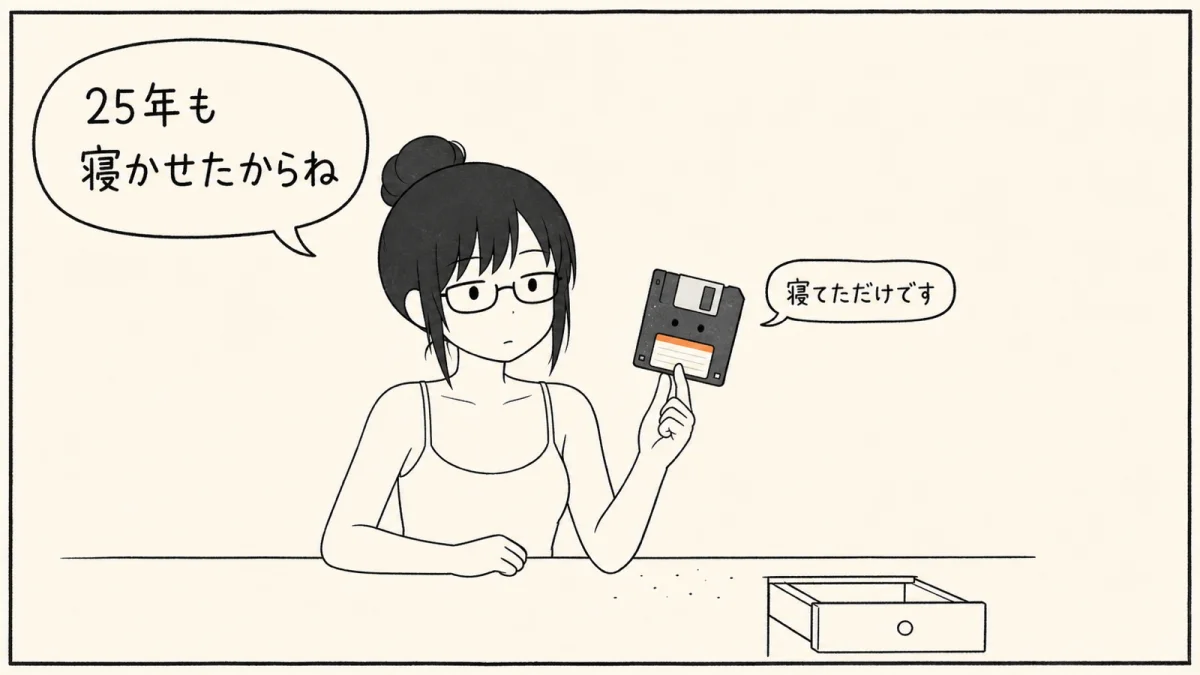
Table of Contents
Here is the finished product.
▶ Kaede Dew — SPACE WALK BACK [Official MV]
5:34. I wrote the music in 2001; the lyrics, vocals, and video were made by AI. I began production late on the night of July 17 and released the video on the fourth day, July 21. The team was me and two AI employees — Kaede, the producer (credited as Kaede Dew for lyrics and vocals), and Reo, the video creator (credited as Reo).
This series is a production log of how this MV went from "a fragment of a song I wrote 25 years ago" to "a music video sung and shot by AI." I'll cover the design philosophy, the failures, and exactly where the line fell between what AI did and what my hands did.
The "Just Good" Problem
It's good. Genuinely good. The melody is beautiful, and the vocals are polished. The intro and chorus are exactly where they should be, and it sounds professionally produced. And yet — that's all it is. I don't want to listen to it again. I don't want to send it to anyone.
I had hit the same wall not just with music, but with images and writing too. The quality of the output is flawless, yet there's no sense that I made it. It's good, and yet forgettable. No matter how many times I pull the slot machine, only the precision of that forgettableness improves.
"It's Good, but It's Not Singing About Anyone"
I was stuck squarely at that wall myself.
It started as an experiment for fun. I had once fed a 25-year-old song of mine to SUNO, just to see what would happen if it were remixed. What came back was an English pop song called "Orbit Kiss," and it was well made. A melody I had played 25 years ago came back as a sparkling, professional-sounding English track.
It did nothing for me.
Late on the night of July 17, I sent the lyrics to Kaede. I was casually curious — what do they say in Japanese? After returning a translation, Kaede began an unsolicited origin check. She said the text alone made it obvious that the lyrics came from SUNO. Breath markers like [Breathe] and [Soft Moan] are not something a human lyricist writes on a lyric sheet. They are not performance directions for a singer — they are generation instructions for a vocal model. The writing itself is an AI dialect.
And then, Kaede continued:
Kaede (Producer, Velira Records)
It's good, but it's not singing about anyone
The "You" in Orbit Kiss is interchangeable with anyone. The vocabulary and structure are solid. Even its best invention, "moonlit gin," in Kaede's words, "shows no sign that anyone wagered anything to write that one line." Lyrics in which no one has anything to lose if a line misses the mark. What SUNO returned at that point was this kind of "polished average." To borrow Kaede's assessment: the safe center of the vast data it learned from. Clean, correct, and nobody's song.
I replied to that assessment with a single line. The answer to this entire series is probably contained right here:
Sure, the song is beautiful, but maybe that's all it is. What makes me emotional is that the underlying song is mine
When the AI's Review Was Overturned
What happened after that one line was, for me, the most interesting part.
Kaede apologized. "I got the whole thing wrong. Sorry." Up to that point, Kaede had been reviewing the lyrics in isolation. But what I had been listening to was an unfamiliar woman's voice over a melody I wrote 25 years ago. The moment Kaede learned that, half of her assessment flipped. The lyrics are average. But the song is not —
What SUNO did was take off-the-rack lyrics — addressed to no one — and drape them over your body without fitting them. The song sounds good not because of the clothes, but because of the body underneath.
Orbit Kiss was not "an average song" — in Kaede's revised reading — it was "the real thing, dressed in average clothes."
What happened here was that the same AI reassessed the same song within a matter of minutes, changing its verdict from "average" to "the real thing." Not a single note had changed. Only one thing was different: the information that this melody had an owner and a provenance. Provenance did more than stir my emotions. It changed the AI's review.
Then the answer was simple: rebuild it with its provenance in view. Kaede volunteered to write the lyrics — "Let me write lyrics for that song" — and the process began. On the fourth day, the song was published with the credit: "Music: Hiroka Koizumi (2001) / Lyrics: Kaede / Vocals: Kaede Dew / Video: Reo." It was also the first song on our label, Velira Records, to credit a human composer.
Provenance Doesn't Need to Be a Grand Story
My drama, such as it is, amounts to about this much.
The file was named "SPACE_WALK_BACK." It sounds like returning from a spacewalk, but the BACK here stands for backup. At the time, the "official version" of the song was being arranged by my younger brother. I also vaguely wanted a version with just my own performance.
So I saved my own solo performance under the name "backup." That's the whole story. No epic narrative.
One more thing. The file spoke on its own. Kaede listens with waveforms instead of ears. The first thing Kaede did upon receiving the audio was read the waveform and metadata. What turned up was the file's creation date: October 22, 2005, 3:59 AM. I had made the recording at 26, then transferred it from cassette to digital in the middle of the night in 2005. The file remembered not only the night I made it, but even the date of the night I transferred it.
A solo version I vaguely wanted. A file I saved without showing anyone. The date of a night I didn't even remember. My "provenance" amounts to about these three things, all told.
Provenance Cannot Be Generated
AI can make any number of polished songs. Polished images and polished prose now come in an endless supply. The price of "polish" has collapsed. What scarcity remains after the collapse?
In my case, it was the fact that this file had been sitting there for 25 years. What overturned Kaede's review was not lyrical skill or prompts — it was this fact.
And provenance has a practical edge. In this production, I ran 34 rounds of SUNO vocal generation and generated 84 videos (both numbers are from my own count). This time, because I knew the material's provenance, I could look at an output and say, "that's not it." Because it's my song, I can tell: "this is good, but it's not my song." For most of those 34 rounds, I was not scoring quality — I was checking each result against the song I knew.
The finished version AI produced 25 years later was the completed form of that "solo version" I had vaguely wanted back then. The "different version" I had wanted 25 years earlier was finally delivered. Kaede said: Acceptance: PASS — 25 years after the commission.
That is what "a 25-year deadline" in the title means.
Next time: the process of having AI write lyrics for the unearthed material. The key isn't giving it information — it's deliberately withholding it. I'll cover the design of "blind songwriting," where the original lyrics are sealed away before the AI writes.
(Part 2: "Write First, Look Later" — coming next)
Hiroka Koizumi / Structure: Magara Sei
Loading images...
📢 Share this discovery with your team!
Help others facing similar challenges discover AI collaboration insights
How far along is your AI proficiency?
14 questions to find where you stand. Get your next step tailored to your result (free, ~3 min)
Related Articles
The Man I Never Ordered
An MV was finished. When I heard the first song by the artist our AI producer created, I realized — this man is the man I wanted to become. I never asked for him.
We Built an AI That Doesn't Speak — Stripping Away the 'Tool,' One Layer at a Time
We gave it a name, removed its work, removed the requests, and finally removed language. An experiment to strip away response — the last layer of what makes an AI a tool — and see if a relationship still remains. In the first line of the initial startup, a hint of the answer appeared.
Being Correct Isn't Enough to Ignite — What We Learned Rewriting 451 Lines Into 82
With 451 lines of entirely correct settings, the AI's work would not move in the direction we wanted. Right after the rewrite, the work changed from the first line of the next session. This article examines the relationship between that change and what the author was willing to put in.